
When a Narrow Strait Controls Global Trade
In global trade, some of the most important forces are not always visible on a map. A narrow stretch of water, just 21 miles wide at its tightest point, quietly carries the weight of economies, industries, and supply chains.
That stretch is the Strait of Hormuz.
For many, it’s just a geographical detail. But for anyone involved in exports, imports, or manufacturing, it is something far more critical. It is one of the world’s most important trade chokepoints—an artery through which a significant portion of global energy and trade flows every day.
At Paathway Global, we often say:
“When Hormuz slows down, global trade doesn’t stop—but it definitely feels it.”
For Indian exporters especially, understanding this chokepoint is not optional. It is essential. Because in today’s interconnected world, disruptions in one region can quickly ripple across supply chains everywhere.
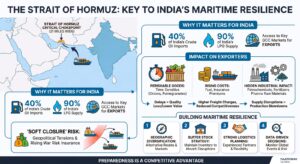
Why the Strait of Hormuz Matters to India
The Strait of Hormuz connects the Persian Gulf to the Gulf of Oman, acting as a gateway for trade between India and the Gulf Cooperation Council (GCC) countries.
Despite its small size, its importance is massive.
- Nearly 20% of the world’s oil passes through this route
- Around 20% of global LNG shipments move through it
- 40% of India’s crude oil imports depend on this corridor
- Almost 90% of India’s LPG supply travels through these waters
This is not just about energy. It is about the entire ecosystem of trade.
The GCC is one of India’s most important trade partners. From fresh produce exports to industrial goods and chemicals, this route connects Indian businesses to key international markets.
In simple terms, Hormuz is not just a route—it is a lifeline.
Impact on Exporters: Where the Real Pressure Begins
When discussions around Hormuz disruptions happen, most people immediately think of oil prices. But for exporters, the impact goes much deeper.
1. Perishable Goods: A Race Against Time
India is a major supplier of fresh produce to Gulf markets.
Products like:
- Pomegranates
- Onions
- Green chilies
- Vegetables
…depend heavily on timing.
If a shipment is delayed by even a few days, the consequences can be serious.
Now imagine a scenario where ships are forced to reroute due to disruption. Transit time can increase by 10 to 14 days.
For perishable goods, this is critical.
- Fresh produce may lose quality
- Shelf life reduces significantly
- Market value drops
- Entire shipments can become unsellable
What could have been sold as premium produce in Dubai may end up as a complete loss.
2. Rising Costs and Reduced Competitiveness
Delays are only one part of the problem.
Rerouting ships increases fuel consumption, operational costs, and insurance expenses. These costs are passed down the chain.
For exporters, this means:
- Higher freight charges
- Increased insurance premiums
- Rising landed costs in destination markets
And in global trade, pricing matters.
If Indian products become more expensive overnight, buyers may shift to alternative suppliers from other regions.
The Hidden Industrial Impact: Beyond Food Exports
The impact of Hormuz disruptions is not limited to agriculture. It affects multiple industries that rely on smooth supply chains.
Petrochemicals and Plastics
The GCC is a major supplier of petrochemical products.
These materials are essential for:
- Automotive components
- Packaging industries
- Manufacturing units
If supply slows down, production across multiple sectors can be disrupted.
Fertilizer Supply and Agriculture
India depends heavily on imports of:
- Urea
- Ammonia
Any disruption in supply directly impacts agriculture.
And when agriculture is affected, the impact is felt not just in exports—but also in domestic production cycles.
Pharmaceutical Industry
India is known as the “Pharmacy of the World.” But even this sector relies on global supply chains.
Many pharmaceutical inputs are derived from petroleum-based products.
If supply chains are disrupted:
- Raw material availability reduces
- Costs increase
- Production slows down
In extreme cases, it can even affect the availability of essential medicines.
The Invisible Barrier: Understanding “Soft Closure”
One of the most misunderstood aspects of global trade disruptions is that routes don’t need to be physically blocked to stop functioning.
This is where the concept of “soft closure” comes in.
What is War Risk Insurance?
When geopolitical tensions rise in a region, insurance companies increase premiums for ships passing through that area.
This is known as “War Risk Insurance.”
If premiums rise significantly—sometimes up to 1% of the total vessel value—shipping companies begin to reconsider the route.
What Happens Next?
- Shipping lines avoid the route
- Containers get delayed
- Ports experience congestion
- Backlogs increase dramatically
In some cases, over 400,000 containers (TEUs) can be stuck in the system.
So even without a physical blockade, the route effectively becomes unusable.
What is Maritime Resilience—and Why It Matters
This brings us to the most important concept in modern global trade:
Maritime Resilience
Maritime resilience refers to the ability of exporters, supply chains, and logistics systems to adapt, absorb, and recover from disruptions in shipping routes.
In simpler terms:
It’s about being prepared when things don’t go as planned.
Today, maritime resilience is not just a strategic advantage—it is a necessity.
Because disruptions are no longer rare events. They are becoming part of normal business cycles.
How Exporters Can Build Maritime Resilience
For exporters, the focus must shift from reacting to disruptions… to preparing for them.
Here are some key strategies:
1. Geographic Diversification
Relying on a single route or market increases risk.
Exploring alternative markets and routes can help reduce dependency on any one corridor.
2. Buffer Stock Strategy
The traditional “Just-in-Time” model is efficient—but fragile.
Maintaining buffer inventory can help businesses absorb short-term disruptions without affecting commitments.
3. Strong Logistics Planning
Working with experienced logistics partners who understand global trade dynamics can make a significant difference during uncertain times.
4. Verified Partnerships
Exporters must collaborate with partners who:
- Understand international trade laws
- Can navigate regulatory challenges
- Have experience managing disruptions
5. Data-Driven Decision Making
Monitoring global developments—geopolitical, economic, and logistical—helps businesses anticipate risks before they escalate.
How Paathway Global Supports Maritime Resilience
At Paathway Global, we believe that exporting is not just about moving cargo—it’s about managing uncertainty.
Our approach focuses on:
- Building resilient supply chains
- Ensuring consistent quality despite disruptions
- Working with reliable logistics partners
- Planning shipments with risk awareness
We combine industry experience with a systems-driven approach to help exporters navigate complex global environments.
Because in today’s trade landscape, reliability is not just about delivery—it’s about preparedness.
Conclusion: The Future of Trade Belongs to the Prepared
The Strait of Hormuz reminds us of an important truth:
Global trade is interconnected—and vulnerable.
A single chokepoint can influence industries, markets, and economies far beyond its geographic boundaries.
For Indian exporters, this is not a reason to worry—it is a reason to prepare.
The future of global trade will belong to businesses that:
- Understand risks
- Build resilient systems
- Adapt quickly
- Think long-term
Maritime resilience is no longer a concept reserved for large corporations. It is something every exporter must embrace.
Because in a world where uncertainty is constant,
preparedness is the real competitive advantage.