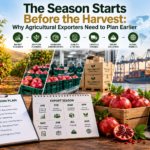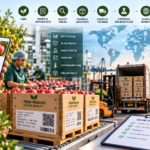

In agricultural trade, the most important export decision may happen before the first crate leaves the farm.
That may sound unusual.
After all, agricultural exports are often discussed around harvest quality, market prices, packaging, logistics and shipment execution. But by the time harvest begins, many of the decisions that determine whether an export programme succeeds have already been made.
The buyer may already have chosen another supplier.
Packaging material may already be committed elsewhere.
Freight capacity may be tighter than expected.
A particular grade may be in short supply.
Testing or certification requirements may take longer than planned.
And a sudden change in weather can alter the availability of exportable produce.
This is why a new discipline is becoming increasingly important for agricultural exporters:
Plan the export season before the harvest season begins.
For Indian exporters, this is becoming particularly relevant as global agricultural markets face greater exposure to weather, logistics and policy-related disruptions. FAO’s 2026 analysis highlights how extreme weather, conflicts, macroeconomic pressures and other shocks can increasingly transmit through international food markets.
The exporter who prepares early is not necessarily trying to predict everything.
The objective is simpler:
Create options before the market forces you to make decisions.
The Export Season Actually Begins Months Earlier
Consider an exporter preparing for a mango, pomegranate, rice or spice season.
The physical product may become available during a defined harvest window.
But the export business begins much earlier.
Before harvest, an exporter can already be working on:
- identifying target markets
- understanding buyer requirements
- estimating available volumes
- planning procurement
- evaluating suppliers
- checking packaging requirements
- reviewing testing requirements
- discussing indicative quantities with buyers
- evaluating logistics options
- preparing working-capital requirements
When these activities are delayed until the harvest begins, the exporter enters the season under pressure.
When they begin earlier, the exporter has more room to respond.
That difference can influence both margins and execution.
Agriculture Does Not Give Exporters Unlimited Time
Manufactured goods can often be produced according to an order schedule.
Agriculture operates differently.
A crop has a harvest window.
Once the harvest arrives, the exporter cannot simply say:
“We will wait another three months for better demand.”
The product may have a limited commercial window.
This creates a unique relationship between agriculture and international trade.
Supply has a clock.
The exporter therefore needs to connect that clock with the buyer’s purchasing cycle.
If a buyer needs product in April, procurement cannot always begin in April.
If a market requires specific packaging, the packaging cannot always be arranged after the produce has already arrived.
If laboratory testing is required, capacity should be considered before the peak season.
Good seasonal planning is therefore about connecting several calendars:
Crop Calendar + Buyer Calendar + Packaging Calendar + Testing Calendar + Logistics Calendar
The stronger the connection, the fewer last-minute decisions the exporter has to make.
2026 Is Showing Why Seasonal Planning Matters
Agricultural markets are currently facing another layer of uncertainty.
The October 2026 AMIS Market Monitor notes that weather concerns, changing production prospects, elevated freight rates and firmer fertilizer markets are contributing to uncertainty in global agricultural markets. It also highlights the strengthening El Niño as an additional risk, particularly for rice production in South and Southeast Asia.
Recent market analysis on Indian rice is already focusing on the potential effect of El Niño on India’s 2026–27 production and export availability. S&P Global reports that Indian rice production could face pressure while buyers are watching availability, prices and emerging markets closely.
This does not mean exporters should try to predict the exact future.
It means they should avoid building an export plan that depends on one assumption.
The Smart Exporter Builds a Season Plan, Not Just a Shipment Plan
A shipment plan answers:
What are we shipping this week?
A season plan asks much broader questions:
How much can we realistically supply?
Which markets should receive priority?
What specifications are likely to be required?
When should procurement begin?
What packaging needs to be booked?
What happens if production is lower than expected?
What happens if demand is stronger than expected?
This changes the exporter’s role from reacting to orders to preparing for opportunities.
For example, suppose an exporter expects 100 tonnes of a particular agricultural product during a season.
Instead of waiting for buyers to appear, the exporter can create a preliminary allocation framework:
- 40 tonnes for confirmed demand
- 30 tonnes for regular customers
- 20 tonnes for new opportunities
- 10 tonnes as operational flexibility
The exact percentages will differ by product and business.
The principle is what matters.
Do not commit every kilogram before the season even begins.
Flexibility has value.
Procurement Should Start With the Export Market
One of the biggest mistakes in seasonal agriculture trading is buying first and finding the market later.
A better approach is to begin with the intended market.
Different buyers may require different:
- grades
- sizes
- varieties
- moisture levels
- packaging
- certifications
- lab parameters
- labelling
- quantities
This means procurement should not simply ask:
“What product is available?”
It should ask:
“What export specification do we need to secure?”
Paathway Global’s current product model reflects this specification-led approach, with its agricultural portfolio covering grains, pulses, spices and oilseeds, while its fresh-produce offering highlights verified farms, traceability, grading, pre-cooling, export packaging and cold-chain readiness.
That approach becomes particularly important during a seasonal supply window.
Packaging Can Become a Seasonal Bottleneck
Packaging is often treated as the final step.
During peak agricultural seasons, that can be risky.
If several exporters require similar cartons, trays, liners or specialised packaging at the same time, availability can become more difficult.
A seasonal exporter therefore needs to think about packaging earlier.
The questions are practical:
What pack sizes will buyers need?
Which packaging formats are already approved?
How much material is required?
How quickly can additional packaging be sourced?
Can packaging be adapted if the buyer changes volume?
This is especially important for fresh produce, where the packaging has to balance protection, ventilation, presentation and transport requirements.
A strong product can still become a difficult export if the packaging plan is late.
Buyer Conversations Should Begin Before Peak Supply
There is another advantage to early planning:
buyers have time to plan too.
An importer may need to coordinate:
- warehouse space
- retail programmes
- distribution
- promotional activity
- inventory
- local transport
- financing
An exporter who approaches the buyer only when the harvest has started may be asking the buyer to make a decision immediately.
An exporter who starts the conversation earlier can discuss the season more intelligently.
For example:
Expected availability: June–August
Indicative volume: 20–25 tonnes per week
Specification: defined grade and size
Packaging: agreed format
Origin: India
Possible shipment window: specific weeks
The conversation becomes more commercial and less speculative.
Early Planning Also Protects Against Supply Surprises
Agricultural supply is never perfectly predictable.
Weather can change.
Harvest dates can move.
Quality can vary.
Domestic demand can increase.
Another exporter may suddenly purchase large quantities.
A supplier may fail to deliver the expected volume.
This is why seasonal planning should include alternatives.
For important products, exporters can maintain:
Primary supplier + secondary supplier + alternative sourcing region
This does not mean buying everything from everyone.
It means knowing where additional supply could come from if circumstances change.
That knowledge can be extremely valuable during a tight season.
India’s Export Growth Makes This Discipline More Important
India’s agricultural and allied exports reached approximately US$53.72 billion in FY2025–26, according to data compiled from APEDA and government sources, while exports during April–June FY2026–27 were reported at about US$13.88 billion, up 6.44% year-on-year.
Fresh fruits and vegetables remain an important part of the export basket, with FY2025–26 exports reported at about US$1.92 billion.
As India’s agricultural export base grows, competition for reliable supply will also become more sophisticated.
Exporters will increasingly need to manage not only:
Where to sell
but also:
When to secure supply.
That is the core of seasonal export planning.
The Best Season Plan Has a “What If?” Section
A practical export season plan should not only describe the expected scenario.
It should also consider alternatives.
What if production falls?
Identify alternative suppliers or origins.
What if demand rises?
Know how quickly additional procurement can be arranged.
What if prices increase?
Understand which buyers and specifications remain commercially viable.
What if freight becomes expensive?
Evaluate alternative shipping windows or routes.
What if a market introduces a new requirement?
Review specifications and documentation before committing volume.
What if the buyer delays the order?
Know where the product could potentially be redirected.
These questions are not pessimistic.
They are basic commercial planning.
From Harvest Management to Market Management
The traditional view of agricultural exporting is:
Grow → Harvest → Pack → Ship
The modern export view is closer to:
Forecast → Plan → Source → Allocate → Harvest → Prepare → Ship → Review
The difference is significant.
The second model recognises that international trade begins before physical movement.
It also recognises that agricultural products have both a biological timeline and a commercial timeline.
The exporter must manage both.
A Simple Seasonal Export Checklist
Before the season begins, exporters can ask:
Market
- Which destinations are being prioritised?
- What demand is expected?
- Which buyers are active?
Product
- What specifications are required?
- Which grades and sizes are commercially relevant?
- What volume is realistically available?
Supply
- Who are the primary suppliers?
- What backup sources exist?
- How consistent is expected quality?
Packaging
- What formats are required?
- Is material available?
- Are packaging suppliers prepared for peak demand?
Quality
- What tests are required?
- What inspection capacity is needed?
- What quality checkpoints should be established?
Logistics
- Which shipping windows are suitable?
- What transit options are available?
- What could cause delays?
Commercial
- What volume is committed?
- What volume should remain flexible?
- What happens if prices move sharply?
This checklist is simple, but it can change how an exporter enters the season.
The Real Advantage Is Having More Choices
Seasonal planning does not guarantee that every shipment will be profitable.
It does something more practical.
It gives the exporter choices.
Choices about suppliers.
Choices about markets.
Choices about timing.
Choices about packaging.
Choices about volume.
Choices about logistics.
And choices about where to allocate limited supply.
That flexibility becomes increasingly valuable when agricultural markets are affected by weather, freight movements, trade policy and changing demand.
FAO’s 2026 work emphasises that global food markets are increasingly exposed to interconnected shocks, while countries are responding by diversifying suppliers and markets and strengthening resilience.
For exporters, resilience does not always require a complicated strategy.
Sometimes it starts with preparing earlier.
The Season Starts Before the Harvest
Agricultural exports are often judged at the destination.
Was the product good?
Was the shipment on time?
Did the buyer reorder?
But those outcomes are influenced by decisions made weeks or months earlier.
The quality of the season is partly determined before the season begins.
For Indian exporters, the opportunity is significant.
India has the agricultural production base, expanding export markets and a growing ecosystem of producers, FPOs, processors and exporters.
The next advantage may come from connecting these resources more deliberately.
Know the market before harvest.
Know the supply before commitment.
Know the packaging before peak demand.
Know the logistics before dispatch.
And know the alternatives before something goes wrong.
At Paathway Global, the emphasis on verified producers, quality systems, compliance, traceability and structured export execution provides a foundation for this kind of planning.
Because in agricultural trade, the shipment may leave the farm in one day.
But the decisions behind a successful shipment should begin much earlier.